
I write and talk a lot about generative AI. And as a freelance writer and editor I find myself increasingly targeted to 'get on board or get left behind.' So now seems the right time to make my professional stance clear (if it isn't already).
I’ve made the decision not to use AI tools on principle – generative AI doesn't align with my personal ethics (and the quality is still poor). I realise it's getting built into a lot of programs, apps and software, but I do what I reasonably can to avoid it.
Some of my clients, partners and colleagues choose to use AI tools, and that's a decision I trust them to make based on their own principles, values and economic drivers. It's all about nuance, not hard lines.
However, I do encourage my clients not to put the original words and guidelines I write for them into LLMs – their content will no longer belong to them. It will become absorbed, diluted and repeated by everyone else's AI output, losing the unique value they commissioned me for.
No AI quality assurance
To reassure my clients – professionally I'm not getting left behind. Generative AI delivers formulaic content based on mediocrity and averages – the opposite of what I'm commissioned to write. It's often riddled with cliches, errors and 'hallucinations.' Again, not helpful.
And so far I’ve seen no tangible evidence of how valuable these AI tools are *for writers and editors specifically.* I see a lot of (alleged) writers and content creators saying I MUST use them, but I don’t see any compelling whys.
There are so many tools that already exist to help with spellchecks, language and grammar guidelines, dictionaries and thesauruses (such a clunky word, I kind of love it), note-taking, fact-checking, research. Some of these online tools now incorporate AI by default, but I personally haven’t found any improvements. Different isn’t always better. New isn’t always better.
Putting aside the argument that outsourcing your thinking and creativity to a tool isn’t a great idea (especially for professional writers) – a lot of people (bots?) are pushing the 'AI is just a tool' argument. Even if I decided to use ChatGPT as I might use a calculator – my calculator isn’t stealing from the artists, writers and musicians I love. It isn’t stealing my words, images, my private data, my clients' data, or my face. And my calculator doesn’t use a ton of energy for every calculation. And if I knew that it did do all these things, I would find an alternative calculator. I don’t envisage myself picking up an abacus anytime soon, but you get the idea.
Luddites unite
Throughout history new technologies and tools have transformed how humans connect and communicate – the printing press, photography, computers, the internet, social media – all game changers. And for society today generative AI is a massive game changer – we can no longer trust what we see or read or hear.
Misinformation is rife: Artists, writers, musicians, craftspeople and designers are having their work stolen every day. There are serious privacy concerns with AI tools. People are being scammed by fake AI-generated products. We're being manipulated by AI-generated algorithms. Small businesses are closing and craftspeople are struggling to be seen amidst a swamp of AI slop. Students’ brains are atrophying through lack of critical thinking. Mental health experts are diagnosing 'AI psychosis.'
The environmental impact is huge – swathes of land are being cleared to make way for new data centres that require vast amounts of water and power. Local communities are suffering, and nuclear power plants are being reopened just to power AI.
And that’s not to say I don’t see the usefulness of AI tools for some people, some of the time. But not for everyone. And not ALL the time. Do I want to rewrite this article with AI? Do I want AI to do my research? Do I want AI to improve the photo I just took of my kids? (NO THEY ARE PERFECT HOW DARE YOU.) Do I want AI to write a text message to my mum? Or send an email to my dad? Do I want AI to write an Instagram caption for me? Do I want AI to change my expression? Do I want AI to read a bedtime story to my children? No. No I don’t. No thank you. Nope.
Did you know the Luddites weren't anti-technology? They were anti-technology being used to exploit and harm workers. That I can get on board with.
A matter of ethics
In a nutshell, the basic premise of generative AI is theft – it's entirely unethical. The techbro owners are making unethical decisions, the platforms that push it are unethical, the unregulated tools are being used for indisputably heinous, immoral purposes, and the data centres it needs to run are disastrous for our environment.
In every area of my life I do my best not to buy from brands that I know go against my personal ethics. I’ve turned down work in the past because I don’t agree with the principles of a business or how they operate. Of course there’s a lot more I could be doing, but I try to do the right thing because it’s the right thing to do – not because it’s the easy thing to do, and certainly not because everyone else is doing it.
Running any kind of business is a balancing act, with a lot of competing needs and wants. But our principles should always be central to decision-making, especially in these divisive times. And especially with how we choose to engage with AI.
A note on sources – I’ve included links to three trusted sources here (the UN, and the brilliant investigative journalists Carole Cadwalldr and Parmy Olsen), but always happy to provide links to other sources (I have a folder because of course I do).
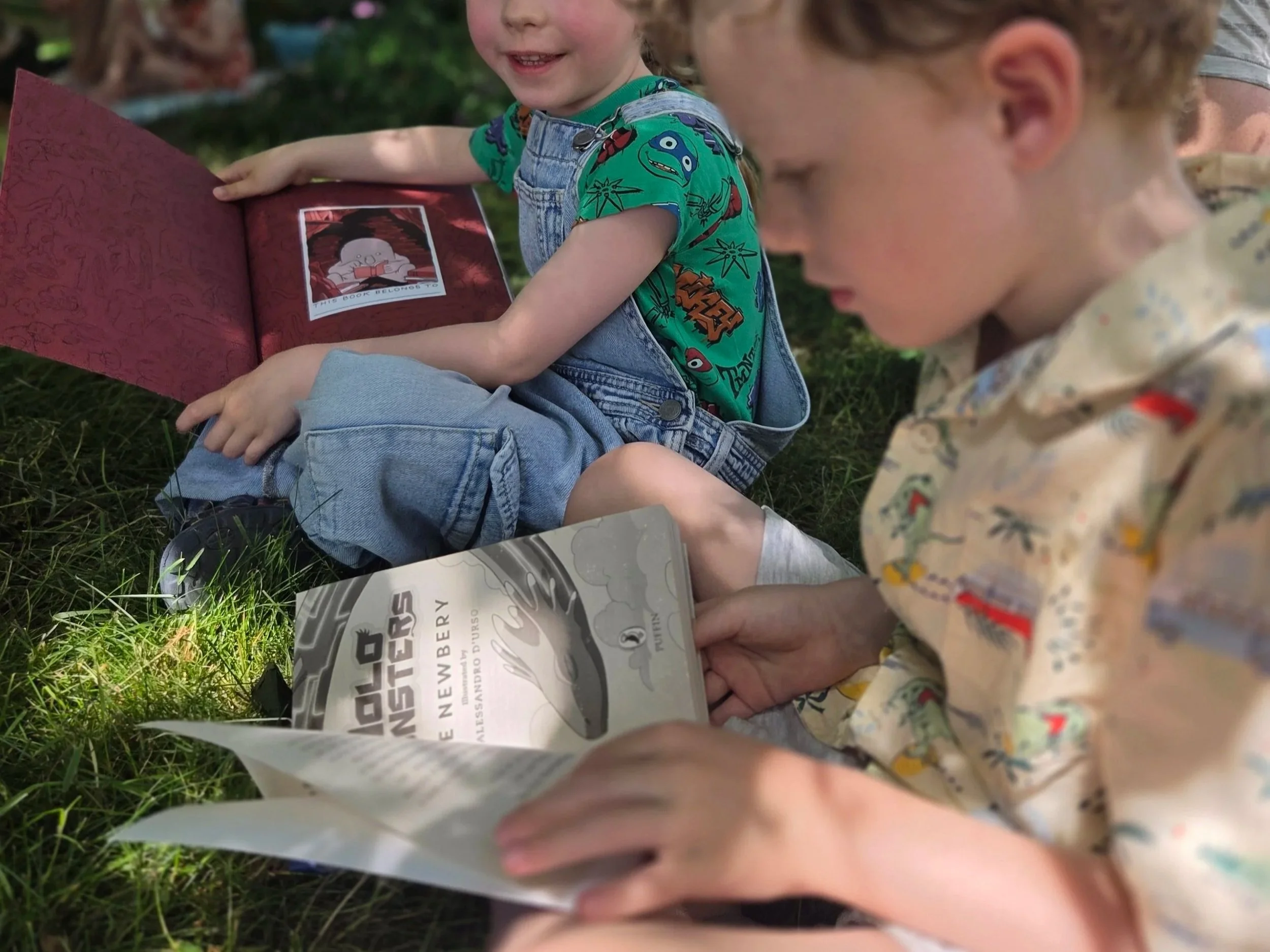
Pictured – my kids at Hay Festival reading original books by very talented humans (Holo Monsters by Lee Newbury, and the Hilda comics by Luke Pearson).